
How to Choose an HVAC Contractor: 12 Questions to Ask
Equipment brand accounts for a small share of how your system performs. Installation quality accounts for most of it. Screen the installer harder than the box.
Connect this button to your email provider (Mailchimp, ConvertKit or Beehiiv) to start collecting subscribers. The form endpoint goes here.
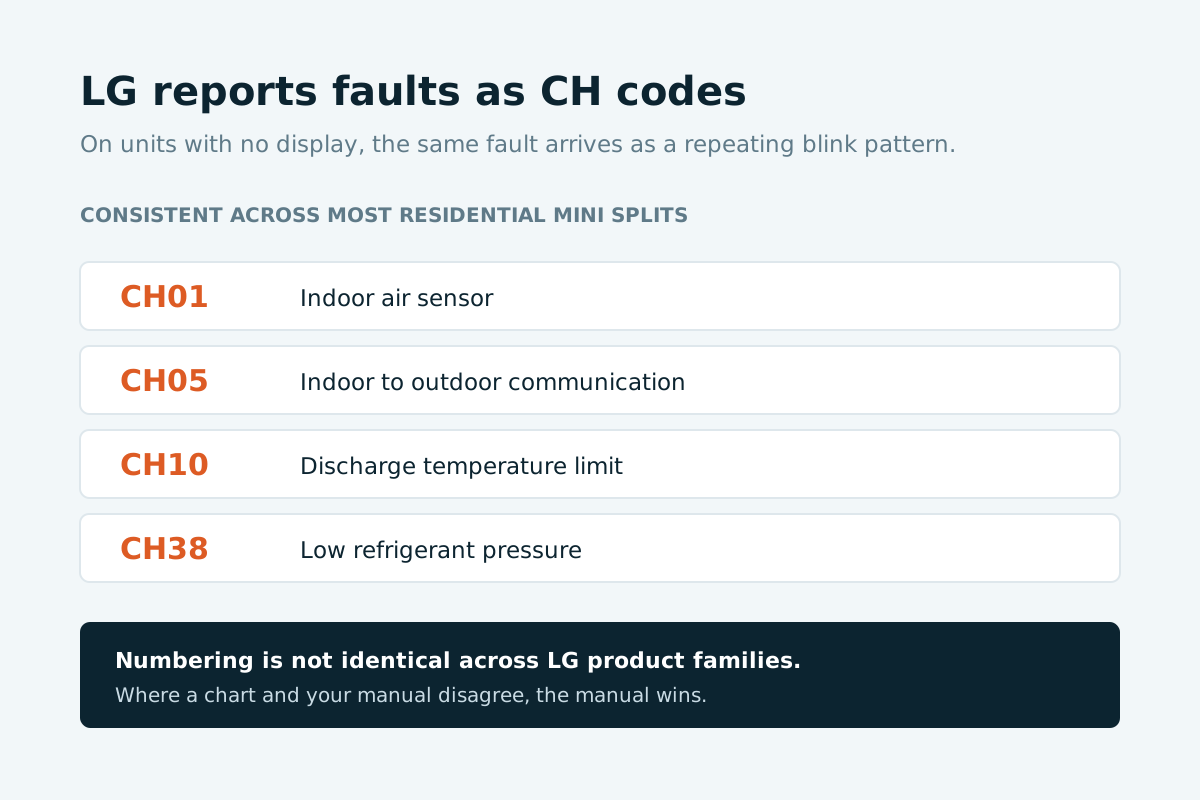
LG shows faults as CH codes, or as blink patterns on units without a display. The numbering is not consistent across product families, which is where most confusion starts.
LG reports faults as "CH" followed by a number, shown on the indoor unit display or the remote. On units without a display, the same fault comes out as a blink pattern on the operation light.
One thing to establish before the code list: LG code numbering is not perfectly consistent across product families. The same CH number can mean different things on a wall-mounted Art Cool, a multi-zone system and a ducted air handler. The chart below covers the meanings that hold across most residential mini splits, but the service manual for your exact model number is the authority, and where you see a discrepancy, trust the manual over any chart including this one.
On units with a display. The code appears directly, in the form CH05, CH38 and so on.
On units without a display. The operation light blinks in a repeating sequence. Count the fast blinks before each pause, and that count is the code number. A rapid burst that repeats, say six quick blinks then a pause then six more, is a fault. A slow, steady blink roughly every two to three seconds is a standby indicator and means nothing is wrong.
Record the number before you cut power. Restoring power clears the stored code, and a technician arriving to a cleared fault has to wait for it to happen again.
| Code | Usual meaning | What tends to cause it |
|---|---|---|
| CH01 | Indoor air temperature sensor fault | Open or shorted sensor circuit, or a disconnected sensor plug |
| CH05 | Communication failure between indoor and outdoor units | Loose or damaged communication wire, terminal corrosion, board damage after a surge |
| CH10 | Discharge temperature exceeded its limit | Usually a faulty discharge thermistor; can also indicate a genuine refrigerant problem |
| CH38 | Low refrigerant pressure | Refrigerant leak |
Two codes worth flagging separately because published charts disagree about them:
CH04 is documented as a drain or float switch fault on some LG lines and as a heat-sink temperature sensor fault on others. Both readings appear in reputable charts. If you get CH04, check the condensate drain first because it is the cheaper and more common cause, then consult the manual for your model rather than assuming.
CH23 is listed among the compressor and DC-link protection codes in LG's own electrical documentation, while a number of consumer-facing guides describe it as a frozen coil from a dirty filter or blocked drain. Treat CH23 as potentially serious: clean the filter and clear the drain, and if it returns, stop and get it diagnosed rather than repeatedly resetting it.
The honest list of homeowner-level steps on an LG mini split is short:
Anything touching the sealed refrigerant circuit, the compressor, the inverter or high-voltage components is not a homeowner job. Refrigerant handling requires EPA Section 608 certification, which is a legal requirement rather than a best practice, and opening those components without training risks both injury and your warranty.
Communication errors are the most common LG fault homeowners encounter and the one most often misdiagnosed as a dead unit. The indoor and outdoor units talk over a low-voltage line, and anything that interrupts that conversation produces CH05: a wire nicked during other work, a terminal loosened by vibration, corrosion in an outdoor connection, or a control board damaged by a nearby lightning strike.
What makes it frustrating is that the system often looks fine. Lights come on, the remote responds, nothing happens. Before assuming a board failure, ask whether anything changed recently: electrical work, landscaping near the line set, a storm, or a recent service visit. That context frequently identifies the cause faster than testing does.
Sensor and communication faults are usually inexpensive. Compressor and inverter faults on an out-of-warranty unit often are not, and on an older system the repair can approach a meaningful fraction of replacement. If you reach that point, our installation cost breakdown and the rebates available in your state are the two numbers that decide it.
Does a CH code mean my LG unit is broken? Not necessarily. Several codes report conditions rather than component failures, and a few clear permanently after the underlying condition, a blocked filter or a clogged drain, is corrected. A code that returns after one power cycle is reporting a real fault.
Why do different websites give different meanings for the same CH number? Because LG uses overlapping code numbers across different product families, and many charts online are copied from a single product line without saying which. The service manual for your model number is the only authoritative source.
Can I keep running the system with a code showing? It depends on the code, and for refrigerant and compressor faults the answer is no. Running a system that is low on refrigerant can destroy the compressor, turning a leak repair into a replacement.
My unit blinks but shows no CH number. That is the blink-pattern method: count the fast blinks between pauses to get the number, then look it up. A slow, even blink every couple of seconds is standby, not a fault.
Homeowners who collect three written quotes typically save 12–18% on the same system. Tell us your ZIP and we will connect you with licensed installers in your area.
Diagnostic steps here are ordered by how often each cause turns out to be the answer, not by how serious it is. That is deliberate: working the common causes first is what saves you a service call, and the rare-but-severe ones are flagged where they apply.
Primary references for the figures and procedures on this page. Where a number here is a range drawn from field experience rather than a published measurement, it is labelled as such in the text.
Last checked September 2026. Rebate amounts and program status change frequently; always confirm against the official program page before you sign a contract.
Equipment brand accounts for a small share of how your system performs. Installation quality accounts for most of it. Screen the installer harder than the box.

Installed prices run from $5,500 for a straightforward single-zone swap to $22,000 for a whole-home ducted system with electrical work. Here is what drives the difference.

The first zone carries the outdoor unit and most of the labor. Every zone after that is comparatively cheap — until you cross the multi-head threshold.

The short answer is yes, and modern cold-climate units are rated to keep producing useful heat down to -13°F. The longer answer is about capacity, not failure.