
How to Choose an HVAC Contractor: 12 Questions to Ask
Equipment brand accounts for a small share of how your system performs. Installation quality accounts for most of it. Screen the installer harder than the box.
Connect this button to your email provider (Mailchimp, ConvertKit or Beehiiv) to start collecting subscribers. The form endpoint goes here.
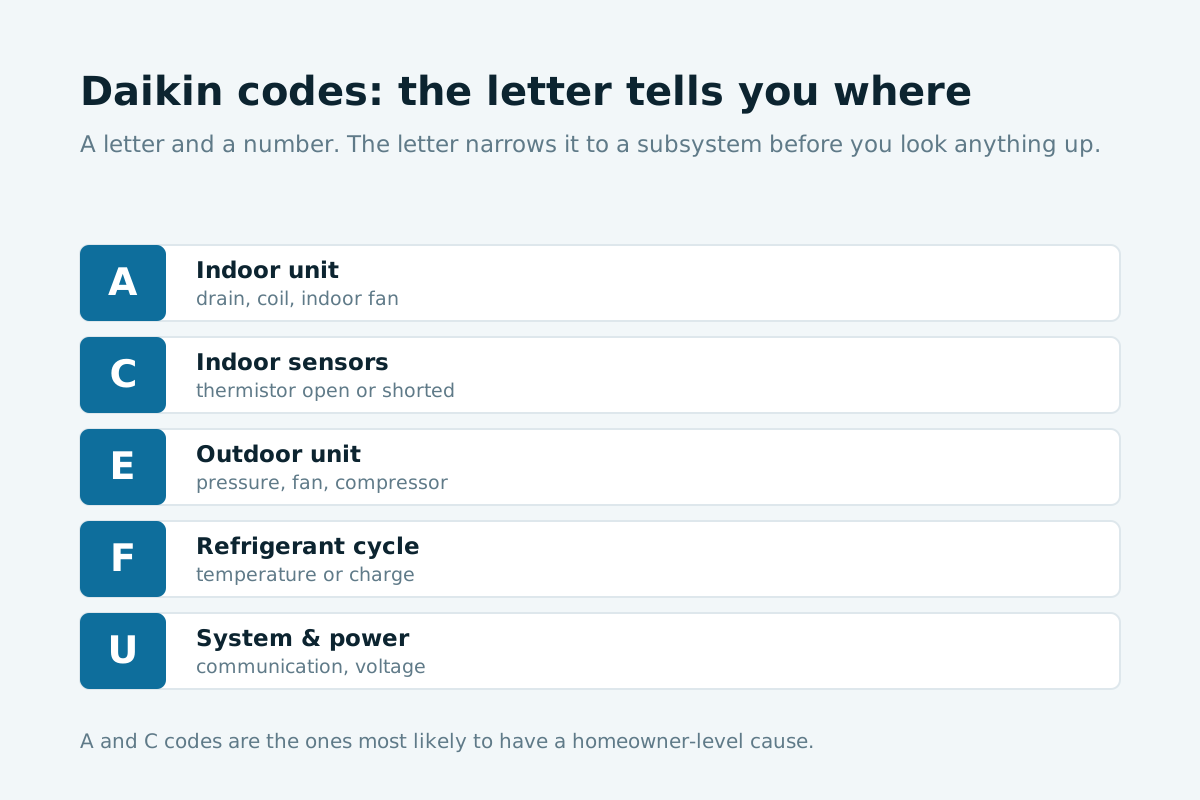
Daikin codes are a letter plus a number, and the letter tells you which subsystem is complaining. That makes them easier to triage than most brands.
Daikin reports faults as a two-character code, a letter followed by a number, and the letter tells you which subsystem is complaining before you look anything up. That structure makes Daikin codes easier to triage than most brands once you know it.
This page covers how to pull a code off the unit, what the letter groups mean, the specific codes homeowners run into most, and which of them you can act on yourself.
The code is often already on the display. If it is not, the method depends on which controller you have.
Wireless remote. Press the inspection button on the remote and hold it for roughly five seconds. The temperature display area starts blinking, typically showing "00" first, and then cycles through codes. Point the remote at the indoor unit while you do this; the unit beeps when the displayed code matches the stored fault.
Wired BRC controller. Press the ON/OFF and FAN buttons at the same time to enter diagnostic mode, which displays the stored code directly.
Blink patterns. If your indoor unit has no display, the fault is signalled by the operation and timer lamps. The number of flashes on each lamp maps to a code in the service manual for your specific model, so this route requires the manual rather than a universal chart.
Write the code down before you clear anything. Power-cycling the unit erases the stored fault, and a technician arriving to a cleared code has to wait for the fault to recur before diagnosing it.
On Daikin units fitted with the Streamer air-cleaning component, a flashing orange timer lamp is a maintenance reminder telling you the Streamer unit needs cleaning. It is not a breakdown and does not stop the system working. Holding the filter indicator reset button for about two seconds clears it. A lot of service calls get booked over this light.
| Letter | Subsystem | Usual character |
|---|---|---|
| A | Indoor unit | Drain, indoor coil, indoor fan motor |
| C | Indoor sensors (thermistors) | Disconnected or short-circuited sensor |
| E | Outdoor unit | Pressure, outdoor fan, compressor protection |
| F | Refrigerant cycle | Temperature or charge problems |
| H, J, L, P | Sensors, inverter and electrical | Component-level faults |
| U | System, wiring and power | Communication, voltage, unit combination |
The practical takeaway: A and C codes usually point at the indoor unit and are the ones most likely to have a homeowner-level cause. U codes point at wiring, power or system configuration. E and F codes involve the refrigerant circuit and are technician territory.
| Code | Meaning | Common causes |
|---|---|---|
| A3 | Drain level control fault | Clogged drain, drain line sloping the wrong way, failed drain pump, stuck float switch |
| A5 | Indoor coil freezing or overheating | Dirty filter, restricted airflow, faulty coil sensor |
| A6 | Indoor fan motor fault | Motor locked, overloaded, or a bad connection |
| C4 / C9 | Indoor thermistor resistance abnormal | Disconnected or short-circuited sensor wire |
| E3 | High pressure too high | Blocked or dirty outdoor coil, restricted airflow, overcharge |
| E4 | Low pressure too low | Low refrigerant, restriction in the piping, faulty pressure switch |
| E7 | Outdoor fan not working | Obstruction, failed fan motor, control board fault |
| F3 | Discharge temperature too high | Low charge, restricted piping, faulty discharge thermistor |
| H6 | Position detection sensor fault | Compressor problem, outdoor board, poor contacts |
| L5 | Inverter overloaded | Failing compressor or inverter board |
| U0 | Suction pipe temperature too high | Low refrigerant, restriction, expansion valve fault |
| U2 | Power voltage problem | Open phase, voltage imbalance, supply fault |
| U4 | Indoor to outdoor communication failure | Damaged communication wire, loose terminal, failed board |
| UA | Unit combination or setup error | Wrong indoor and outdoor pairing, or an incorrect field setting |
A3. Start with the condensate drain. A clogged line or a section that slopes upward is the most frequent cause, and clearing a blocked drain is within normal homeowner maintenance. If the line is clear and the code persists, the pump or float switch has failed and needs a technician.
A5. Check the filter first. A dirty filter starves the coil of airflow, which makes it freeze in cooling. Clean or replace it, let any ice melt completely, then restart. If it recurs with a clean filter, the cause is deeper: blocked coil, failed sensor, or low charge.
E7. Look at the outdoor unit before calling anyone. Leaves, snow drift or debris jammed in the fan is common and free to fix. Kill power at the disconnect before clearing anything from the fan.
U4. Sometimes a genuine wiring fault, sometimes a loose terminal after recent work. It is worth a single power cycle at the breaker to rule out a transient, but repeated U4 codes mean the communication wiring or a control board needs inspecting.
U2. Points at the electrical supply rather than the equipment. Check whether other circuits in the house are behaving oddly. Recurring U2 is a job for an electrician as much as an HVAC technician.
Everything on the E, F, H and L lists involves the sealed refrigerant circuit, the compressor or the inverter. Those require an EPA Section 608 certified technician, and refrigerant work without that certification is a federal violation, not just a bad idea.
If you are weighing whether the repair is worth it against replacement, our installation cost breakdown covers where the money goes on a new system.
Will resetting the unit fix the error? It clears the code, which is not the same as fixing the cause. A reset is reasonable once, to rule out a transient glitch, and our reset guide covers doing it properly. A code that returns is reporting a real fault.
Are Daikin codes the same as Goodman codes? No, despite Goodman being Daikin-owned. The product lines use different control platforms and different code sets. Use the chart for the brand on the unit.
My unit shows no code but is not heating properly. Not every problem sets a code. Low airflow, a dirty filter, a thermostat configuration error or a normal defrost cycle can all cause poor heating without any fault being logged. Start with cold air on heat mode.
Does an error code void my warranty? No. What can affect a warranty claim is unauthorised work on the sealed system, or a compressor warranty that was never registered within the manufacturer's deadline.
Homeowners who collect three written quotes typically save 12–18% on the same system. Tell us your ZIP and we will connect you with licensed installers in your area.
Diagnostic steps here are ordered by how often each cause turns out to be the answer, not by how serious it is. That is deliberate: working the common causes first is what saves you a service call, and the rare-but-severe ones are flagged where they apply.
Primary references for the figures and procedures on this page. Where a number here is a range drawn from field experience rather than a published measurement, it is labelled as such in the text.
Last checked September 2026. Rebate amounts and program status change frequently; always confirm against the official program page before you sign a contract.
Equipment brand accounts for a small share of how your system performs. Installation quality accounts for most of it. Screen the installer harder than the box.

Installed prices run from $5,500 for a straightforward single-zone swap to $22,000 for a whole-home ducted system with electrical work. Here is what drives the difference.

The first zone carries the outdoor unit and most of the labor. Every zone after that is comparatively cheap — until you cross the multi-head threshold.

The short answer is yes, and modern cold-climate units are rated to keep producing useful heat down to -13°F. The longer answer is about capacity, not failure.